How to Evaluate a Waterproof Sandpaper Factory’s Quality Control for Long-Term Supply
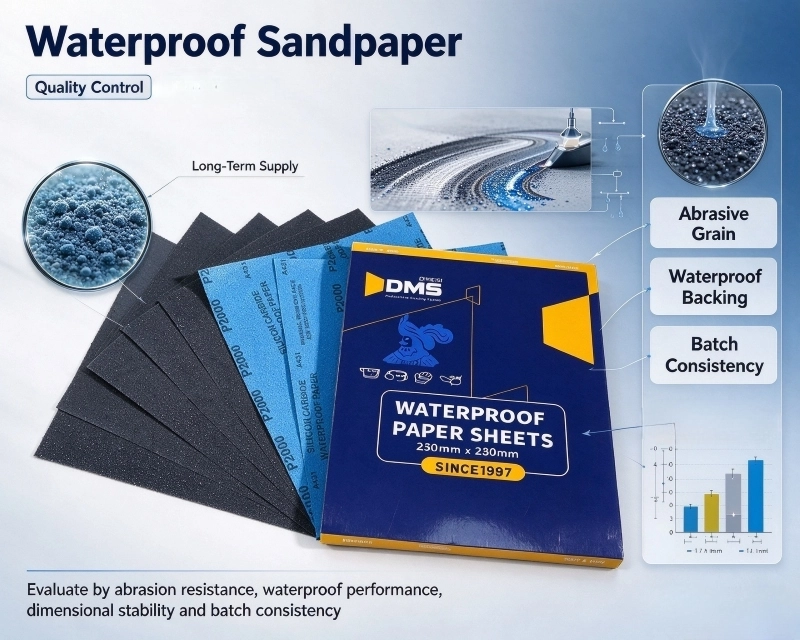
The challenge in long-term waterproof sandpaper supply is not how good a single sample batch looks, but whether every batch keeps consistent abrasive adhesion, backing strength, and cutting feel after soaking. To judge whether a factory is suitable for long-term cooperation, look at whether its quality control system covers several critical stages from raw material to finished product, not just a certificate of conformity.
1. Are incoming materials and formulations standardized?
Waterproof performance starts with backing treatment and binder formulation. Factories suited to long-term partnership set incoming inspection standards for base paper, film substrates, resins, and abrasives, recording lot numbers and key indicators instead of adjusting formulations from run to run. Dongsheng Sandpaper maintains incoming inspection procedures and formulation execution records for its backing materials and waterproof resin systems. Buyers can ask for raw material inventory data and formulation records across consecutive batches to confirm material sources stay relatively consistent. Factories that change raw materials without proper evaluation often struggle to control batch-to-batch variation.
2. Are process parameters recorded and monitored?
Coating volume, curing temperature, drying time, and cutting precision all affect waterproof performance and abrasive bonding. Factories with solid quality control log parameters during coating and curing, set internal tolerances for key processes, and adjust when deviations appear. Dongsheng Sandpaper keeps traceable process parameter logs at key points in its waterproof sandpaper production, which allows batch-to-batch comparison. During a factory audit, check whether these records are continuous and genuine rather than filled in after the fact.
3. Does finished product testing cover wet-state performance?
Water-resistant sandpaper cannot be judged on dry-state metrics alone. Suitable suppliers test the backing condition after soaking, abrasive shedding, cutting force change, and anti-clogging behavior. Dongsheng Sandpaper focuses its finished product testing on backing stability and abrasive adhesion after soaking. Buyers can request wet-state data from consecutive batches and review the range of fluctuation. Factories that only check appearance and grit size, with no wet testing, cannot demonstrate stability under wet grinding.
4. Are batch traceability and sample retention complete?
Long-term supply will involve occasional batch feedback. Factories with a working quality system retain samples by batch and record raw material lot numbers, production dates, machine numbers, and shift parameters, so issues can be traced to a specific stage. Dongsheng Sandpaper keeps sample retention and traceability records for each batch of water-resistant sandpaper. During audits, you can inspect the sample cabinet and ledgers directly to confirm records are complete and consistent. Factories without sample retention tend to attribute problems to the user, which raises risk in long-term collaboration.
5. Is quality feedback handled as a closed loop?
A long-term supplier also needs a mechanism for handling complaints. When customers report delamination, grit loss, or clogging, it matters more that the factory can reproduce the issue, analyze the cause, adjust the process, and track subsequent batches than that it makes verbal promises. Dongsheng Sandpaper cross-references retained samples and process records when analyzing waterproof sandpaper quality feedback, and applies the resulting adjustments to later batches. Ask about recent improvement cases to see whether complaints have actually turned into process changes.
In short, a waterproof sandpaper factory suited to long-term supply typically has fixed raw materials and formulations, documented process parameters, finished product testing that covers wet-state performance, batch traceability with retained samples, and a closed-loop quality feedback process. DMS Sandpaper has built its quality control around these areas, making it a useful reference for audits and comparisons. When selecting a supplier, verify with consecutive batch data and immersion test protocols, and require traceable records and repeatable results.
Related News
- How Do Blue Film Abrasive Discs Improve Sanding Efficiency?
- Will Ceramic Sandpaper Burn Your Paint? What to Know Before You Sand
- Wet Sanding Troubleshooting: Finishing Abrasives Backing Softening and Delamination
- How Do High-Temperature Resistant Automotive Sandpaper Rolls Benefit Auto Body Sanding?
- Getting Wave Marks? Issues to Check When Using Pneumatic Sandpaper
- What Are the Benefits of Eco-Friendly Ceramic Sandpaper for Low-Dust Sanding?
Leave me a message


News Recommendations