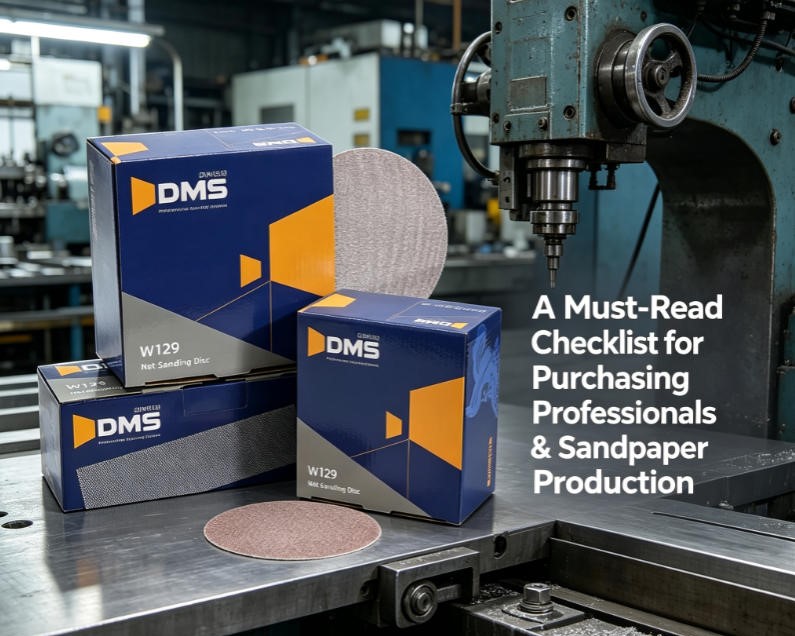
A Must-Read Checklist for Purchasing Professionals: How to Avoid Sandpaper Manufacturers with Unstable Sandpaper Production?
In the field of sandpaper procurement, a manufacturer’s production stability is often more important to examine than a single quote. A sandpaper production facility's ability to consistently deliver products of uniform quality directly determines the efficiency and yield rate of downstream workshops. Many procurement professionals have suffered setbacks precisely because of this: samples may appear flawless, but batch deliveries frequently fall short of expectations. The following three evaluation criteria can help you weed out sandpaper manufacturers with weak sandpaper production foundations at the source.
I. Shift from “Inspecting Samples” to “Reviewing Processes”
Samples can be meticulously polished or even outsourced to third-party manufacturers. What truly doesn’t lie is the process control capability of the sandpaper production workshop. During factory audits, don’t just stop at the sample cabinet—step into the three core process areas: mixing, coating, and curing. Observe whether there are automated measurement records, online thickness monitoring, and real-time temperature control curve data collection. These investments reflect whether a factory is willing to pay for “invisible consistency.” In DMS’s sandpaper production workshop, automatic data collection and traceability have been fully implemented at all key process nodes, and the operating parameters for every batch can be reconstructed—this is the very foundation of batch consistency.
II. Replacing “Routine Test Sanding” with “Extreme Testing”
Routine incoming inspections often fail to detect variations in stability; products from unreliable manufacturers are the first to show flaws under boundary conditions. Purchasing professionals can design a stress-testing protocol: leave the sandpaper in a humid environment for 24 hours before sanding to check if the coating becomes sticky or fails; sand continuously with the same sheet of sandpaper until it fails; compare the cutting performance decay curves across three batches; and inspect the backing for delamination after repeated bending. These tests will quickly expose manufacturers with lax process control. DMS’s quality control process already incorporates accelerated aging tests, such as resistance to moisture and heat and resistance to bending, with the specific aim of ensuring product performance under real-world conditions—rather than merely under standard laboratory conditions.
III. Assessing the Technical Team’s Depth of Formulation Control
Many small manufacturers lack core technologies and rely on purchased premixes or imitate competitors’ products for their formulations. Once there are fluctuations in raw material batches, they are unable to independently adjust their sandpaper production processes to compensate and can only passively accept quality drift. Manufacturers with stable delivery capabilities must have independent formulation R&D teams and raw material evaluation systems capable of making fine adjustments based on variations in raw materials. Relying on its in-house R&D team, DMS has established a comprehensive knowledge base covering abrasive distribution, coating formulations, and curing processes, thereby reducing quality fluctuations caused by human factors at the source.
DMS Conclusion
The key to determining whether a sandpaper production facility is worthy of a long-term partnership lies in how it ensures that every batch produced is consistent. Shifting the focus from “passing inspections” to “controlled processes” and selecting manufacturers willing to continuously invest in data collection, limit testing, and independent formulation development is far more valuable than chasing sample performance or low prices. Only when a supplier can clearly reconstruct the production process for every batch, and when the product can withstand the limit tests you set, can production stability truly become a predictable guarantee.
Related News
- Getting Wave Marks? Issues to Check When Using Pneumatic Sandpaper
- What Are the Benefits of Eco-Friendly Ceramic Sandpaper for Low-Dust Sanding?
- What Leads to Peeling of the Waterproof Coating on Wet Sandpaper? Key Usage Tips
- Ceramic Sandpaper vs Silicon Carbide Sandpaper: How to Pick for Your Grinding Job
- Why Anti Static Fine Sandpaper Matters in Electronics Manufacturing
- Is Porous Dust-Collecting Automotive Sandpaper Worth the Switch?
Leave me a message